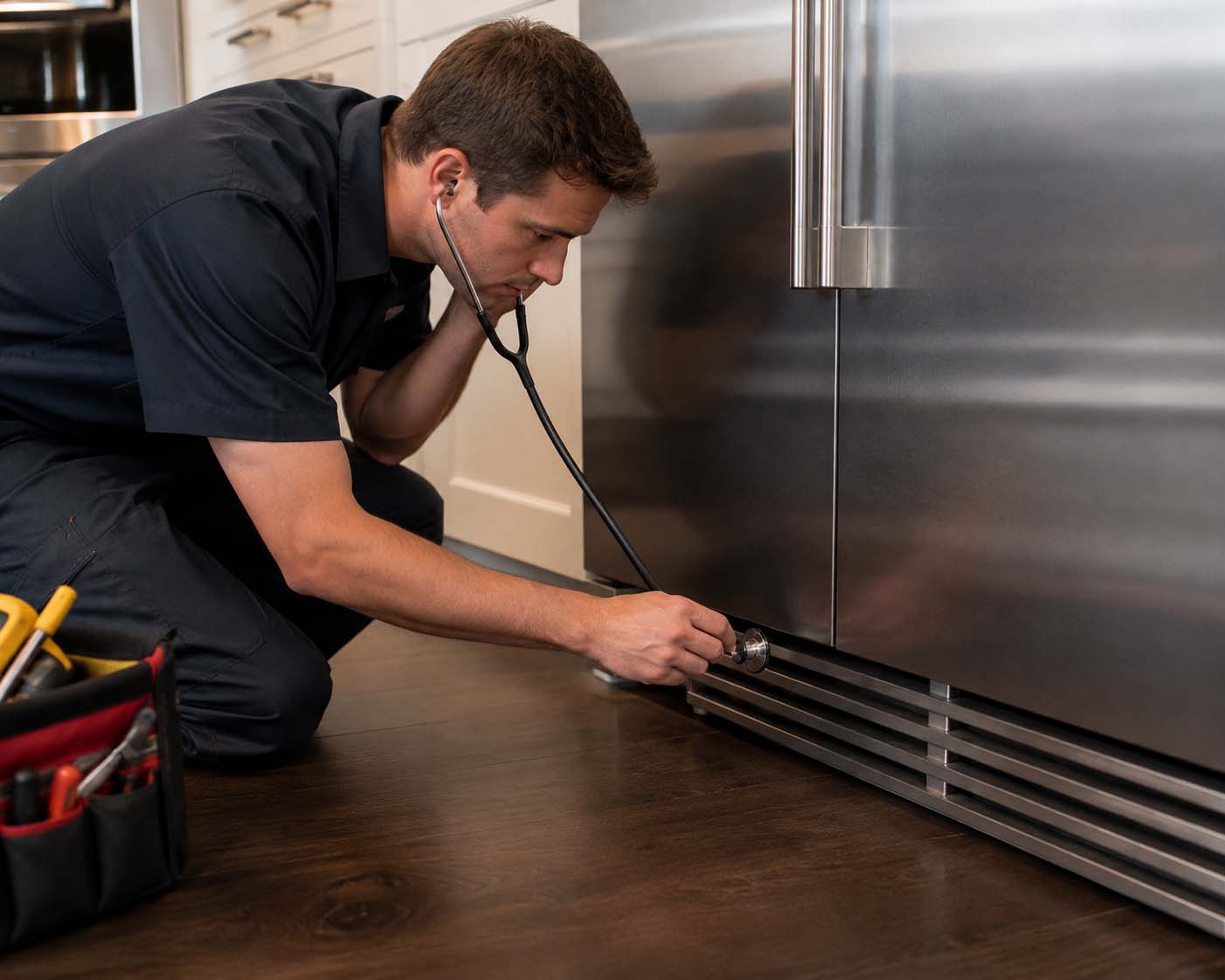
Thermador appliances are repaired by three groups: Thermador factory-authorized servicers booked through Thermador directly, independent companies whose technicians are certified on the BSH (Bosch/Thermador) platform, and general appliance repair shops. For a $3K–$15K appliance, choose from the first two — platform training and OEM parts are what separate them from the third.
The question behind the question is really “how do I avoid the wrong tech” — because a misdiagnosed control board or an off-spec aftermarket sensor costs more than the visit you were trying to save on. This guide gives you the vetting checklist: what certification actually means, the questions to ask before booking, and the red flags that predict a bad repair. Thermador Repair Group’s technicians are certified on Thermador appliances and repairs carry a warranty — you can check availability in your area here.
The three types of Thermador servicers
Factory-authorized servicers are dispatched or listed by Thermador itself (through its Find a Servicer tool) and perform in-warranty work. Certified independents are companies whose technicians trained on the BSH platform — Thermador is built by the Bosch group, so a tech fluent in Bosch/Thermador/Gaggenau architecture is working on familiar hardware. General repair shops handle every brand, which is fine for a basic dryer but risky on a built-in column whose condenser lives in the toe-kick and whose boards store fault memory a generalist may not know how to read.
In-warranty repairs have one hard rule: use an authorized servicer, because unauthorized work can void the manufacturer’s warranty. Out of warranty, a certified independent is usually faster to schedule and equally capable — the credential to check shifts from “authorized” to “trained on this platform, using OEM parts.”
The 5 questions that vet any Thermador tech
Ask these before booking, in this order. First: “Are your technicians trained or certified on Thermador (BSH) appliances?” — a confident yes with specifics beats a vague “we do all brands.” Second: “Do you install OEM parts?” — on this platform, sensors and boards are calibrated to spec, and an off-spec aftermarket part reads wrong all day. Third: “What is the diagnostic fee, and does it apply toward the repair?” — industry diagnostic fees typically run $100 to $150 per Sears Home Services, and reputable companies credit it against the repair. Fourth: “Do you provide a written quote before work begins?” Fifth: “What warranty covers the repair itself?” — parts-and-labor coverage on the work is the mark of a company that expects its repairs to hold.
Our post on what happens during a Thermador diagnostic visit walks through what a professional first visit should look like, step by step.
Red flags that predict a bad repair
Decline the booking if you hear any of these: a quote given over the phone before anyone has seen the appliance (real diagnosis needs live readings), no diagnostic fee at all (legitimate diagnosis has a cost; “free” usually gets recovered in inflated parts pricing), pressure to replace rather than repair a unit under 15 years old, refusal to name the parts brand, or no warranty on the work. On luxury appliances, a wrong first repair is expensive twice — you pay for the bad fix, then for the correct one.
Why platform certification matters more on Thermador than on mass-market brands
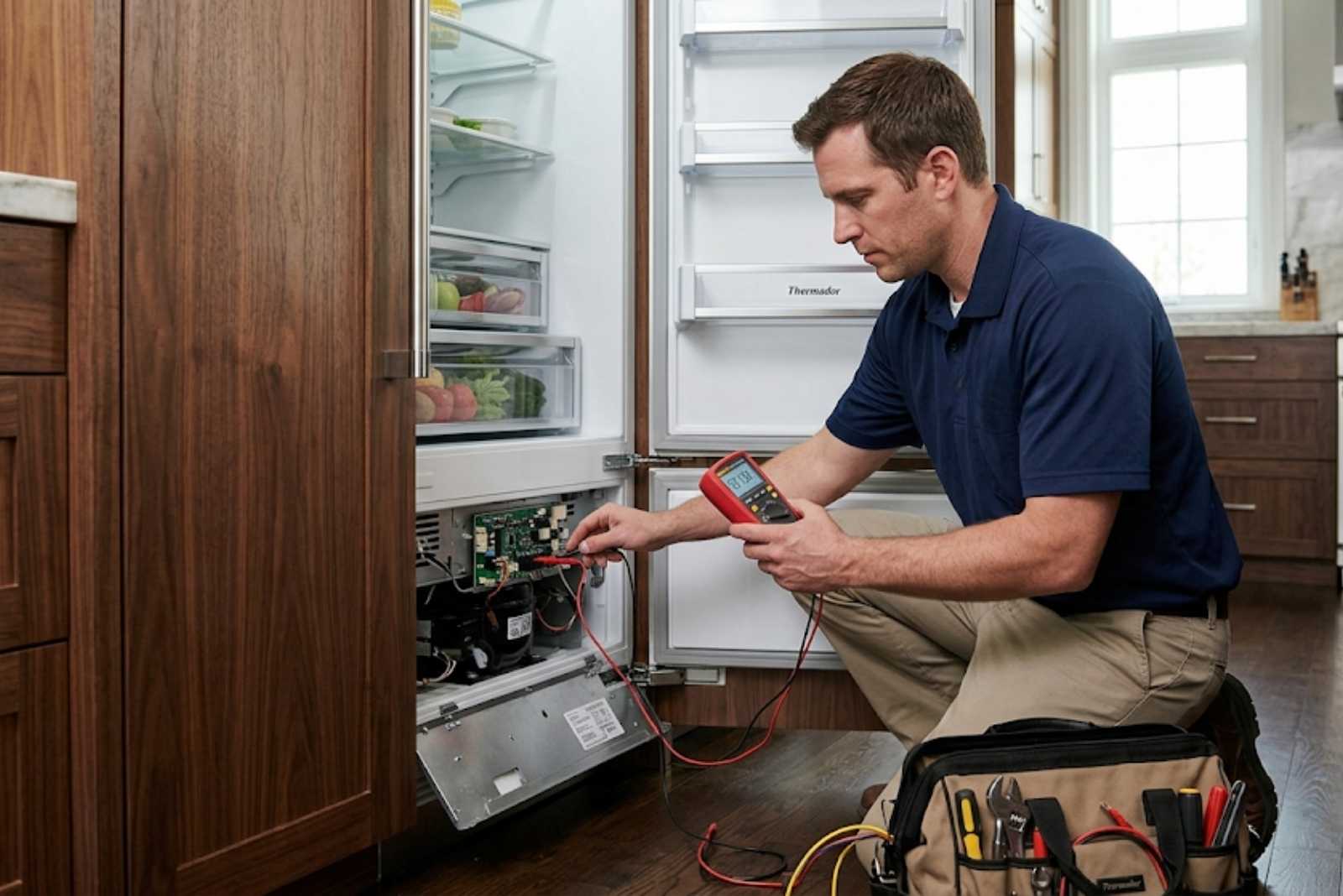
Thermador runs a layered diagnostic architecture: a main control board reads a network of sensors, stores fault codes, and makes every heating and cooling decision from those readings. A certified tech reads that fault memory with brand-specific diagnostic tools, tests sensors against spec (an oven cavity sensor should read about 1,080 ohms at 70°F), and replaces the component the data condemns — not the one guesswork suggests. That is the difference between a one-visit fix in the standard $200–$600 repair band, per Sears Home Services, and a parts-cannon approach that swaps boards until something works.
It also matters for the appliance’s lifespan: certified repairs with OEM parts are one of the three habits that carry Thermador appliances to the 20-year mark — see how long Thermador appliances last.
Frequently asked questions
Can any appliance repair company work on Thermador?
Legally yes, practically no. Out of warranty, you can hire anyone — but Thermador’s BSH-platform electronics, built-in installations, and sealed systems reward brand-specific training. In warranty, the rule is strict: repairs must be performed by an authorized servicer or the warranty can be voided. Either way, the vetting question is the same — platform training plus OEM parts.
Does using an independent repair company void my Thermador warranty?
During the warranty period, unauthorized repair work can void coverage — so for a unit still under Thermador’s warranty, book through an authorized servicer. Once the warranty has lapsed, an independent company certified on the platform doesn’t void anything, and typically offers faster scheduling. Always keep repair invoices either way; they document the appliance’s service history.
How much does a Thermador repair technician cost?
Expect a diagnostic fee of roughly $100 to $150, which reputable companies apply toward the repair, and standard repairs in the $200 to $600 range with complex jobs above $1,200, per Sears Home Services. Appliance repair labor generally runs $50 to $125 per hour according to HomeGuide, with premium brands at the upper end.
Vet once, keep the number forever
Picking a Thermador tech well is a one-time job: ask the 5 questions, confirm OEM parts and a repair warranty, and you have a service relationship for the life of the kitchen. Thermador Repair Group answers all five the right way — certified technicians, genuine parts, written quotes, and warrantied repairs, with same-day availability in many areas. Book a certified Thermador technician here, or browse our Thermador repair services by appliance.