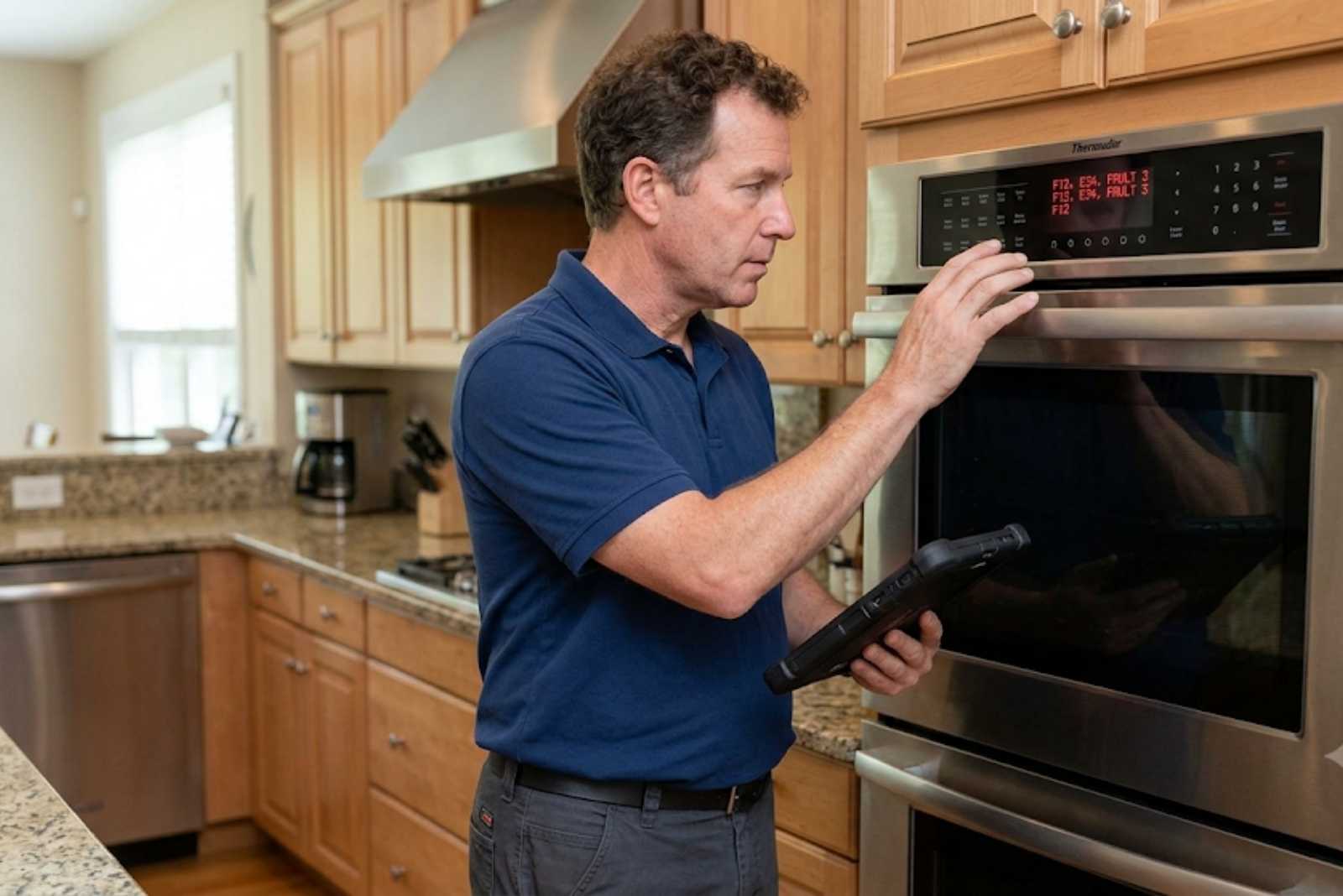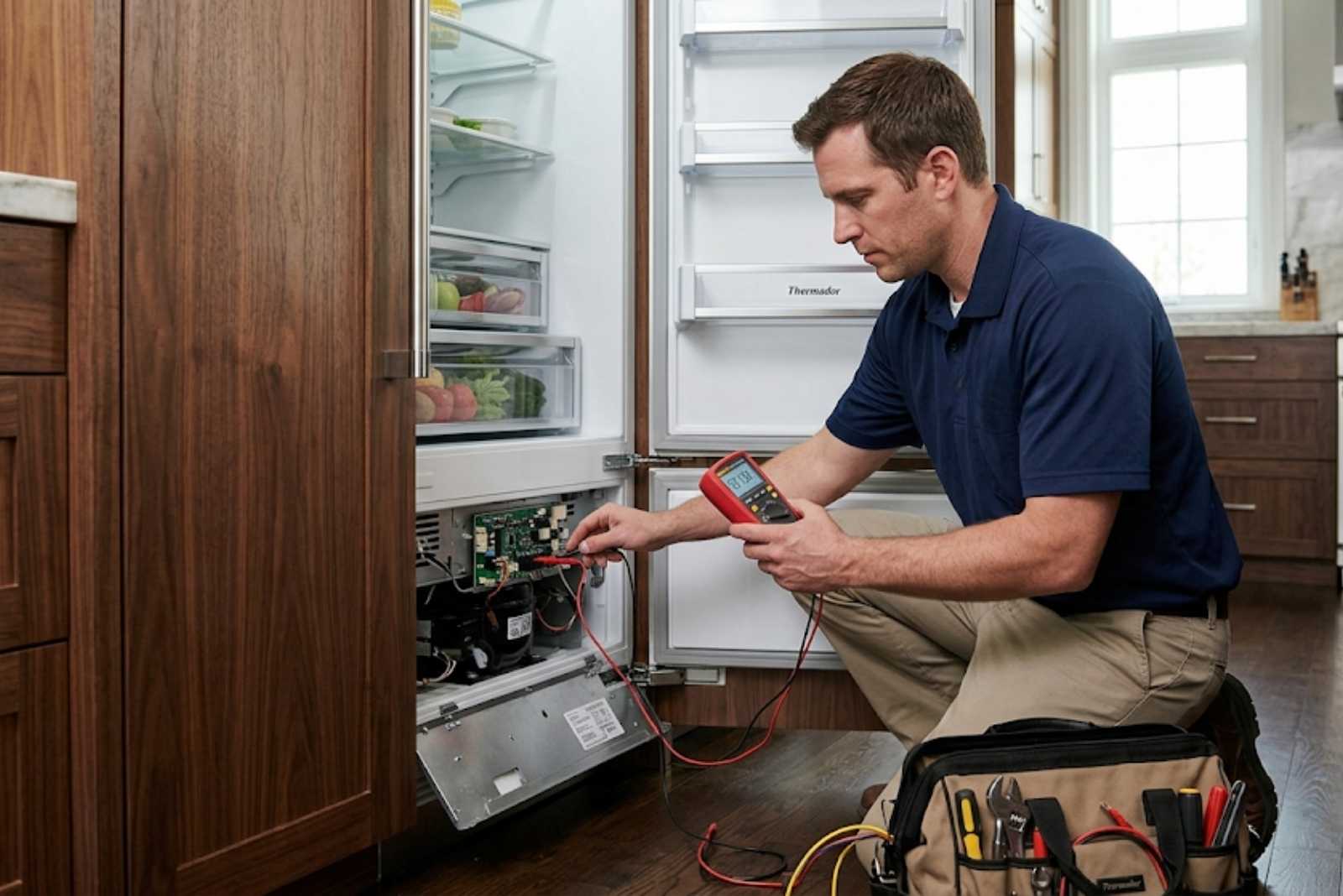
Thermador and Sub-Zero built-in refrigerators are both engineered for roughly 20 years of service, and both are repairable for their full lifespan. The practical differences are warranty depth — Sub-Zero’s 2/5/12-year structure vs Thermador’s 2-year full coverage plus extended sealed-system terms — parts pricing, and where each brand puts its condenser.
This is a repair company’s comparison, not a showroom one: which built-in is easier and cheaper to keep running once the honeymoon is over. Both brands earn their reputations, so the honest answer lives in the details — warranty tiers, condenser access, compressor architecture, and parts ecosystems. Thermador Repair Group services Thermador refrigeration nationwide with certified technicians; if your column needs attention now, book a diagnostic.
Warranty coverage: Sub-Zero’s headline vs Thermador’s fine print
Sub-Zero’s warranty is the industry benchmark: 2 years full parts-and-labor, 5 years full coverage on the sealed system, then a 12-year limited warranty on sealed-system parts (compressor, condenser, evaporator, drier, tubing) — with labor billed to the owner in that 12-year tier, per Sub-Zero’s published warranty terms. Thermador covers refrigeration with a 2-year full warranty plus extended sealed-system coverage, per Fuse Specialty Appliances’ comparison.
The practical read: for years 1–2 the brands are equivalent. In years 3–12, a sealed-system failure favors the Sub-Zero owner on parts — but note the fine print both ways: “limited” means labor and refrigerant service are still billed, and sealed-system failures are the rarest failure class on both brands. The parts that actually fail in a unit’s first decade — ice makers, sensors, fans, boards — are out of warranty on both after year 2.
Serviceability: architecture decides the repair bill
Condenser access differs usefully. Thermador built-in and Freedom columns put the condenser in the toe-kick at the base — cleanable with a vacuum at floor level, and serviceable without pulling the unit. Sub-Zero built-ins house the compressor/condenser section up top behind the grille. Both are deliberately serviceable-in-place designs; the toe-kick is easier for owner maintenance, the top module keeps components away from floor dust.
Compressor architecture is the bigger cost driver. Many Sub-Zero built-ins run a dual-compressor, dual-refrigeration system — excellent for food preservation, and it means two compressors that can each eventually need service. Thermador columns run one sealed system per unit. Neither design is “worse”; they distribute risk differently, and on both brands a sealed-system job is the expensive rarity while sensors and ice makers are the common, modest repairs.
Repair cost and parts: where the bills differ
Purchase price sets the baseline: buyers spend about $4,000 more on average for a Sub-Zero than a comparable Thermador, per Friedmans Appliance — and that premium tends to echo in parts pricing. Standard Thermador repairs run about $200 to $600, with complex work above $1,200, per Sears Home Services; Sub-Zero component repairs occupy a similar band with OEM parts typically at a premium. Thermador’s quiet advantage is the ecosystem: it’s built by BSH (the Bosch group), so its platform shares parts logistics and trained-technician density with Bosch and Gaggenau. Sub-Zero counters with its factory-certified network, which is deep in metro areas.
For component-level Thermador ranges (ice maker, board, sealed system, compressor), see our Thermador refrigerator repair cost guide.
Longevity: a tie that maintenance decides
Sub-Zero units average about 20 years of service, per Albert Lee Appliance, while Thermador built-ins are engineered to remain functional up to 20 years against a 14-year average refrigerator. In our experience the deciding variable isn’t the badge — it’s condenser airflow, gasket condition, and whether faults get repaired while they’re small. A neglected unit of either brand loses years; a maintained one of either brand reaches its engineering target. The routine is identical and takes minutes — see the Thermador maintenance checklist.
Frequently asked questions
Is Sub-Zero cheaper to repair than Thermador?
Not usually — the brands sit in the same luxury repair band, with Sub-Zero parts often pricing at a premium consistent with its roughly $4,000 higher purchase price. Sub-Zero’s edge is warranty depth on sealed-system parts through year 12; Thermador’s edge is the BSH parts ecosystem shared with Bosch. For the common repairs — ice makers, sensors, fans — expect similar bills on both.
Do Thermador and Sub-Zero refrigerators last the same?
Effectively yes: both are engineered for roughly 20 years, roughly 6 years beyond the 14-year average refrigerator. Published lifespans give Sub-Zero a durability reputation edge from its dual-refrigeration design, while Thermador matches the 20-year ceiling with proper care. Maintenance quality moves the outcome more than the brand choice does.
Which is easier to get serviced, Thermador or Sub-Zero?
It depends on your area. Sub-Zero’s factory-certified network is strong in major metros; Thermador benefits from the wider BSH (Bosch/Thermador/Gaggenau) technician base, since a Bosch-platform-trained tech is at home on Thermador hardware. In either case the vetting rule is the same: platform-trained technician, OEM parts, written quote — the checklist is in who repairs Thermador appliances.
The honest verdict
Choose Sub-Zero for maximum sealed-system warranty depth and you’ll pay the premium up front; choose Thermador for equivalent engineered lifespan at a lower entry price with a broad parts ecosystem. From the repair bench, both are keepers: repair-friendly, built-in-serviceable, and worth fixing deep into their second decade. If you own the Thermador side of this comparison, our refrigerator repair service keeps it on the 20-year path — book a certified technician.