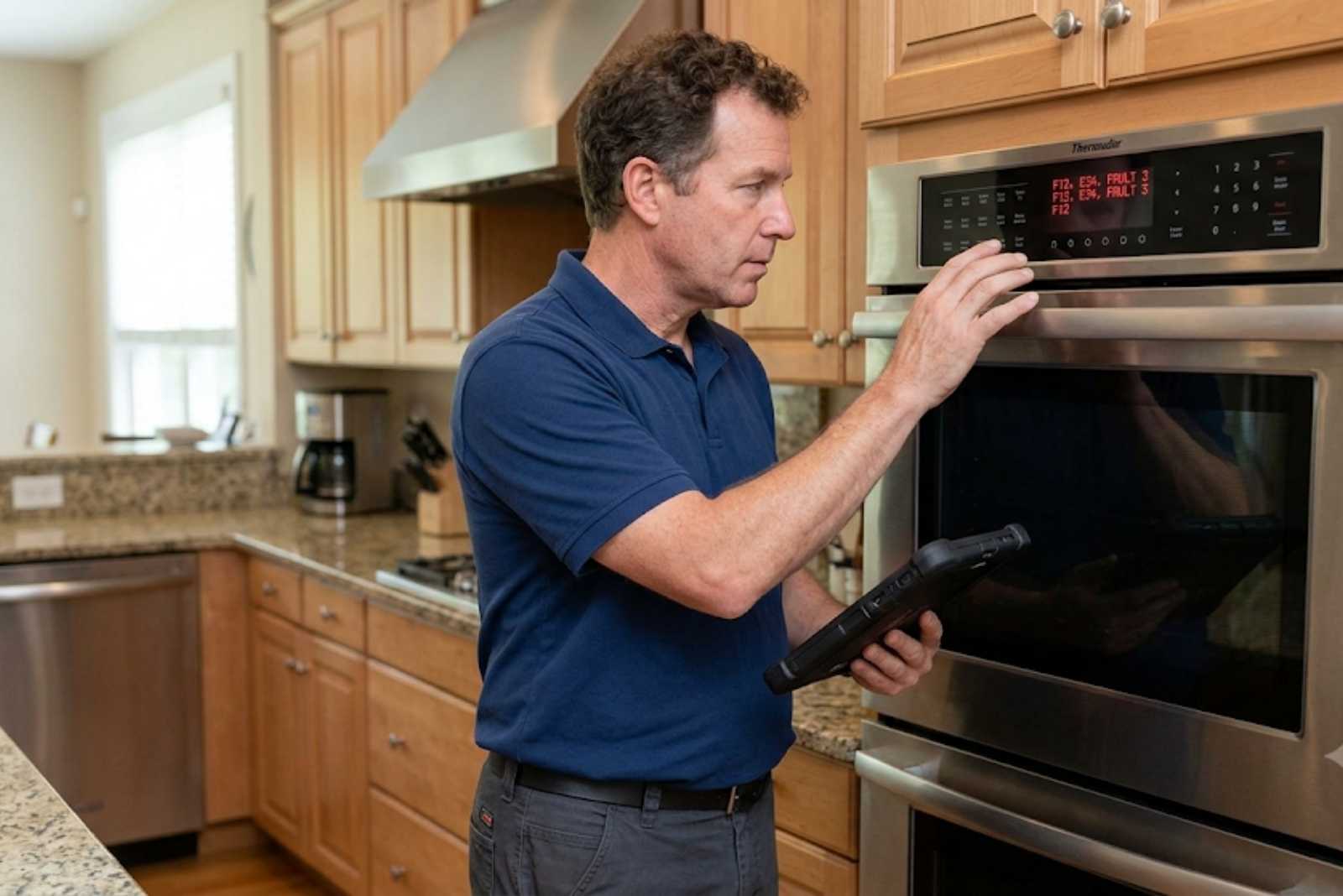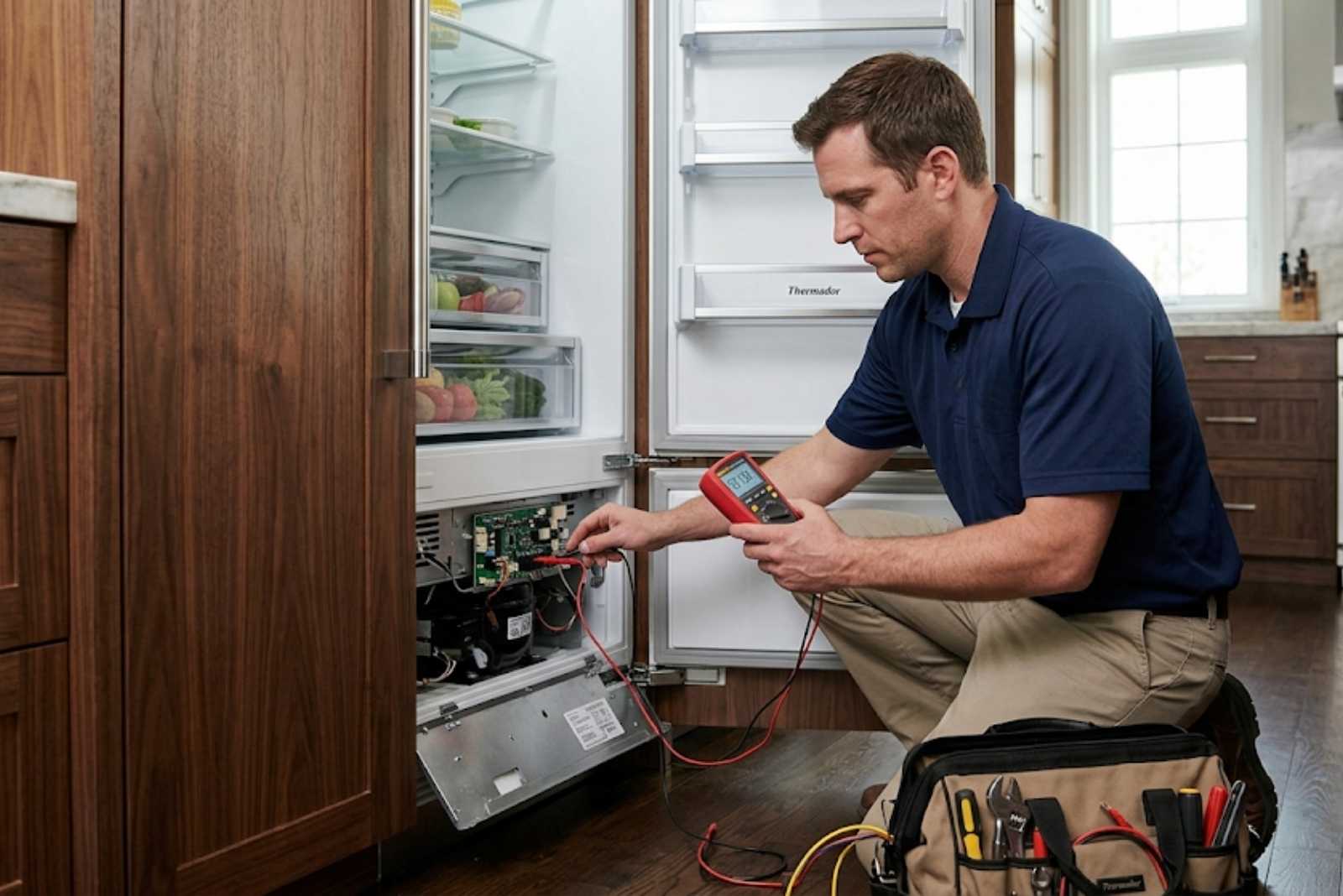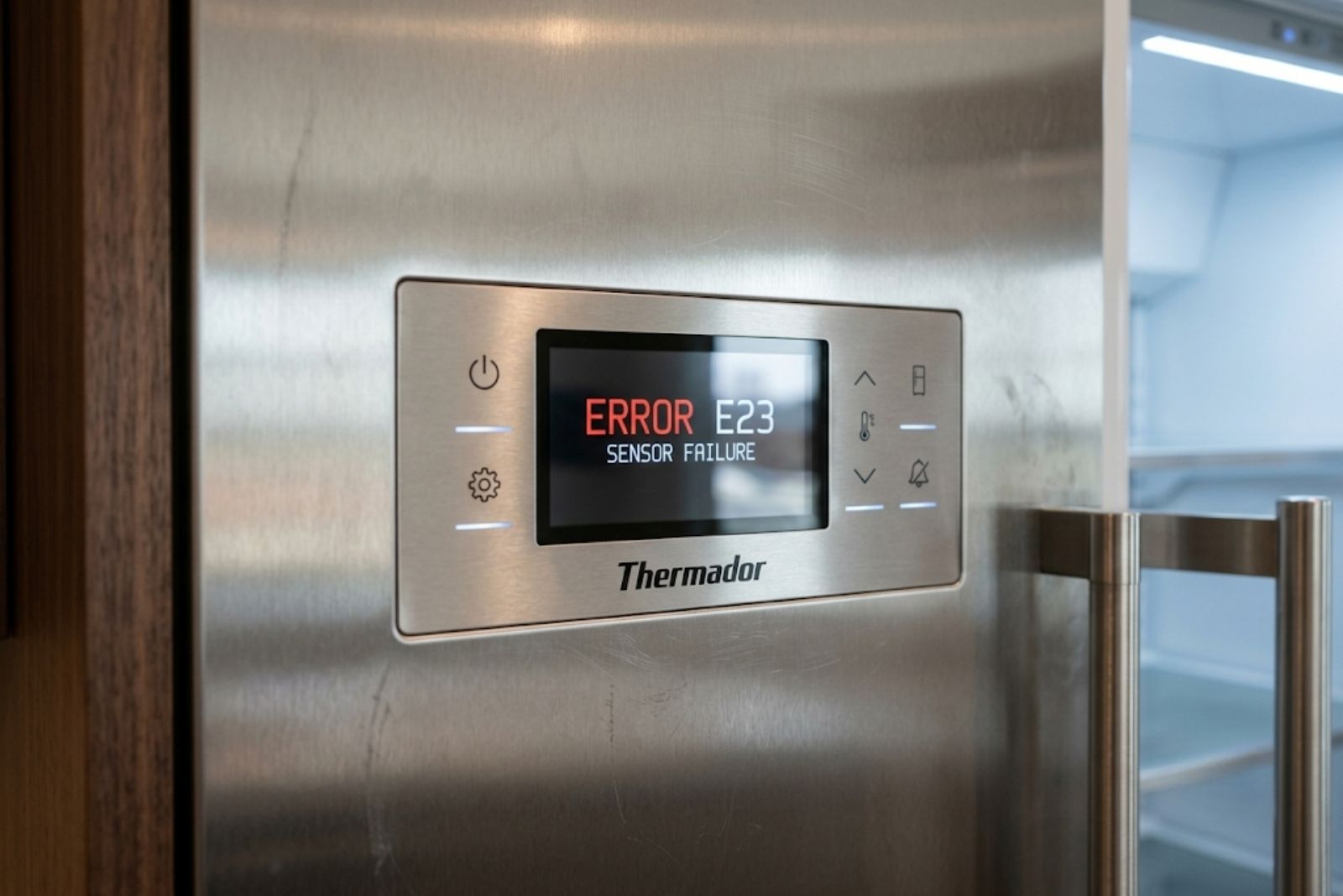
Thermador refrigerator error codes are E-series faults — E01 through E20 — that flag a failed sensor, a communication fault, or a module error. To reset, switch the unit off at the breaker for about 5 minutes and restore power. If the code returns, or the unit stops cooling, book a certified technician.
A built-in Thermador refrigerator runs on a network of temperature sensors reporting to a main control board, and every code points to a specific link in that chain. This guide covers the documented E-codes, the correct reset sequence (including after a power outage), and which codes put your food at risk. Thermador Repair Group provides certified repair for Thermador built-in and Freedom Collection refrigeration nationwide — if a code won’t clear, book a service visit.
How to reset a Thermador refrigerator or freezer
Switch the unit off at its circuit breaker (or unplug it, if accessible), wait about 5 minutes, and restore power. The control board reboots, and a code caused by a one-time glitch — a power surge, a stalled software routine — clears for good. Keep the doors closed during the reset; a built-in column holds safe temperatures for the few minutes this takes.
One rule matters more than the reset itself: write down the exact code first. The fault memory is what tells a technician which sensor failed, and a code you can quote when booking usually means the right part arrives on the first visit.
How do I reset a Thermador refrigerator after a power outage?
After power returns, the display may show a high-temperature alarm or flash a code because the compartments warmed while the power was out. Silence the alarm at the control panel, give the unit 24 hours to pull back down to temperature, and only treat a code as a real fault if it persists once temperatures have stabilized. Check food safety separately: anything above 40°F for more than 2 hours shouldn’t be kept.
Documented Thermador refrigerator error codes (partial list)
Thermador does not publish a full public code table, so the list below covers codes consistently documented in appliance service literature, per Appliance Helpers’ Thermador refrigerator code reference. Treat it as partial — and never force an unlisted code to match.
| Code | Meaning | Risk level |
| E01 | Refrigerator compartment sensor fault — control board can’t read one or more fridge sensors | Moderate — cooling may drift |
| E02 | Freezer compartment sensor fault — same failure on the freezer side | High — frozen food at risk |
| E05 / E06 | Refrigerator evaporator sensor unreachable — often wiring between sensor and board | Moderate — defrost timing fails, ice builds on the evaporator |
| E07 | Freezer evaporator sensor unreachable | Moderate to high |
| E10 | Power module software/firmware failure | Module reset or replacement |
| E11 | Display module software failure | Low — cooling usually continues |
| E15 | “Refrigerator too warm” signal — if the unit is actually cold, the sensor itself is faulty | Verify with a thermometer |
| E20 | Power module and display module not communicating — usually wiring | Technician diagnosis |
Of the 8 documented E-code families, 6 trace back to sensors or their wiring rather than the cooling system itself — which is why a code on a unit that still cools is usually a modest repair, not a compressor failure. A thermistor swap is typically a one-visit fix; a sealed-system fault is a different class of job entirely.
Codes vs alarms: not every beep is a fault
Thermador refrigeration also signals conditions that aren’t component failures. A door-open alarm sounds when a door sits ajar; a high-temperature alarm fires after an outage or after loading a large amount of warm food. These clear on their own once the condition resolves — no reset, no service. An E-code that stays on the display after a breaker reset is the signal that separates a fault from an alarm.
Which codes put your food at risk
Act fastest on freezer-side codes (E02, E07) and any code paired with rising compartment temperatures. Put a thermometer in each compartment: fridge at or below 40°F, freezer at 0°F. If temperatures are climbing, move critical items to backup storage and book same-day service rather than waiting out a second reset. One practical tip from the service side: keep the unit running before the technician arrives — a running unit lets them read live sensor data, while a unit that’s been off for a day hides the fault.
Diagnostics on built-in columns go beyond the code itself. On Freedom Collection and built-in models, the condenser sits in the toe-kick at the base of the unit — a blocked toe-kick makes the compressor overwork and can trigger temperature faults, so a technician checks airflow there before condemning any part. Our Thermador refrigerator repair and Thermador freezer repair pages cover what a certified visit includes.
Frequently asked questions
Will unplugging my Thermador refrigerator clear the error code?
It clears the display, and if the fault was a one-time glitch it clears the problem too — cut power for about 5 minutes, then restore it. If the code returns within hours or days, the control board is re-detecting a genuine hardware fault, most often a temperature sensor or its wiring. At that point repeated resets just delay the repair.
Why is my Thermador refrigerator beeping with no error code?
Beeping without a code is almost always an alarm, not a fault: a door ajar, or a high-temperature alert after a power outage or a big warm grocery load. Close the door fully, silence the alarm at the panel, and give the unit a few hours to recover. If beeping continues with both doors sealed and temperatures normal, then book a diagnostic.
Is a Thermador refrigerator error code expensive to fix?
Usually not, relative to the appliance. Most documented E-codes point to sensors, wiring, or modules, and standard repairs on Thermador appliances run about $200 to $600 according to Sears Home Services, with complex jobs costing more. On a built-in unit worth $8,000–$12,000+, a sensor-level repair is a small fraction of replacement — see our Thermador refrigerator repair cost guide for component-by-component ranges.
Clear it once, then get it diagnosed
The playbook is short: note the exact code, reset once at the breaker for 5 minutes, and watch the temperatures. A code that returns is a component asking to be replaced — and on Thermador refrigeration, catching a sensor fault early is what keeps a modest repair from becoming an evaporator ice-up or spoiled freezer. Book a certified Thermador technician and quote the code when you call. For symptom-based help (warm fridge, leaks, noise), start with our Thermador refrigerator troubleshooting guide.